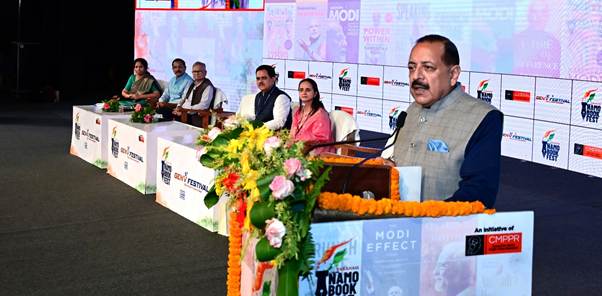
New Delhi, Oct 8 (SocialNews.XYZ) Union Minister of State for Science & Technology and Earth Sciences Dr Jitendra Singh said on Thursday that the opening of India’s space sector to private players has created new opportunities for young scientific and technical talent and helped reduce the need to seek employment abroad.
The sector’s liberalisation has enabled private startups such as Skyroot to absorb talent and broaden the domestic space ecosystem, the minister said.
Addressing students at the NaMo Book Fest in Varanasi, Dr Jitendra Singh said, “the age of silos is over,” stressing that government institutions, private industry, startups, academia and research institutions must work together to build capabilities that can compete globally.
The opening of the sector has transformed space from a predominantly government-led domain into a wider ecosystem in which young professionals and private enterprises can participate, the statement from the Department of Space cited the minister.
Space technology is increasingly being used for infrastructure planning, project monitoring and disaster management, the statement added.
Dr Singh told students that India’s space story is no longer limited to rockets and launch missions, adding that Indian satellites are also providing information to neighbouring countries such as Nepal, Bangladesh, Myanmar and Sri Lanka to help them prepare for floods and other disasters.
The minister said the last 12–13 years have been an “era of science” in India, with technology receiving high policy priority and being increasingly used to improve lives.
India had the scientific talent and human resources for decades, but the enabling policy environment required to convert that potential into national capability has strengthened significantly in recent years, he said.
The minister cited the Deep Ocean Mission and the Anusandhan National Research Foundation among the initiatives creating capabilities in emerging scientific fields. India through the Deep Ocean Mission is exploring the enormous scientific and economic potential of its oceans, including resources that have remained largely unexplored, he said.
Dr Singh also referred to the opening of the nuclear sector to private participation and India’s target of 100 GW of nuclear energy capacity by 2047, with nuclear power emerging as an important clean-energy source for future requirements, including AI and data centres.
He said the increased priority accorded to research is reflected in the rise in GERD from around 46,000–47,000 crore in 2013–14 to around 2–2.5 lakh crore.
—IANS
aar/pk
Source: IANS
Gopi Adusumilli is a Programmer. He is the editor of SocialNews.XYZ and President of AGK Fire Inc.
He enjoys designing websites, developing mobile applications and publishing news articles on current events from various authenticated news sources.
When it comes to writing he likes to write about current world politics and Indian Movies. His future plans include developing SocialNews.XYZ into a News website that has no bias or judgment towards any.
He can be reached at gopi@socialnews.xyz
This website uses cookies.


